The Thing ItselfBaltimore, 1890
The talking board is the séance with the medium removed. Two or more people rest their fingers on a pointer; the pointer moves to letters; the letters spell. It was patented in 1891 by a Baltimore syndicate who had been selling it for a year already, and it has never once gone out of production since.
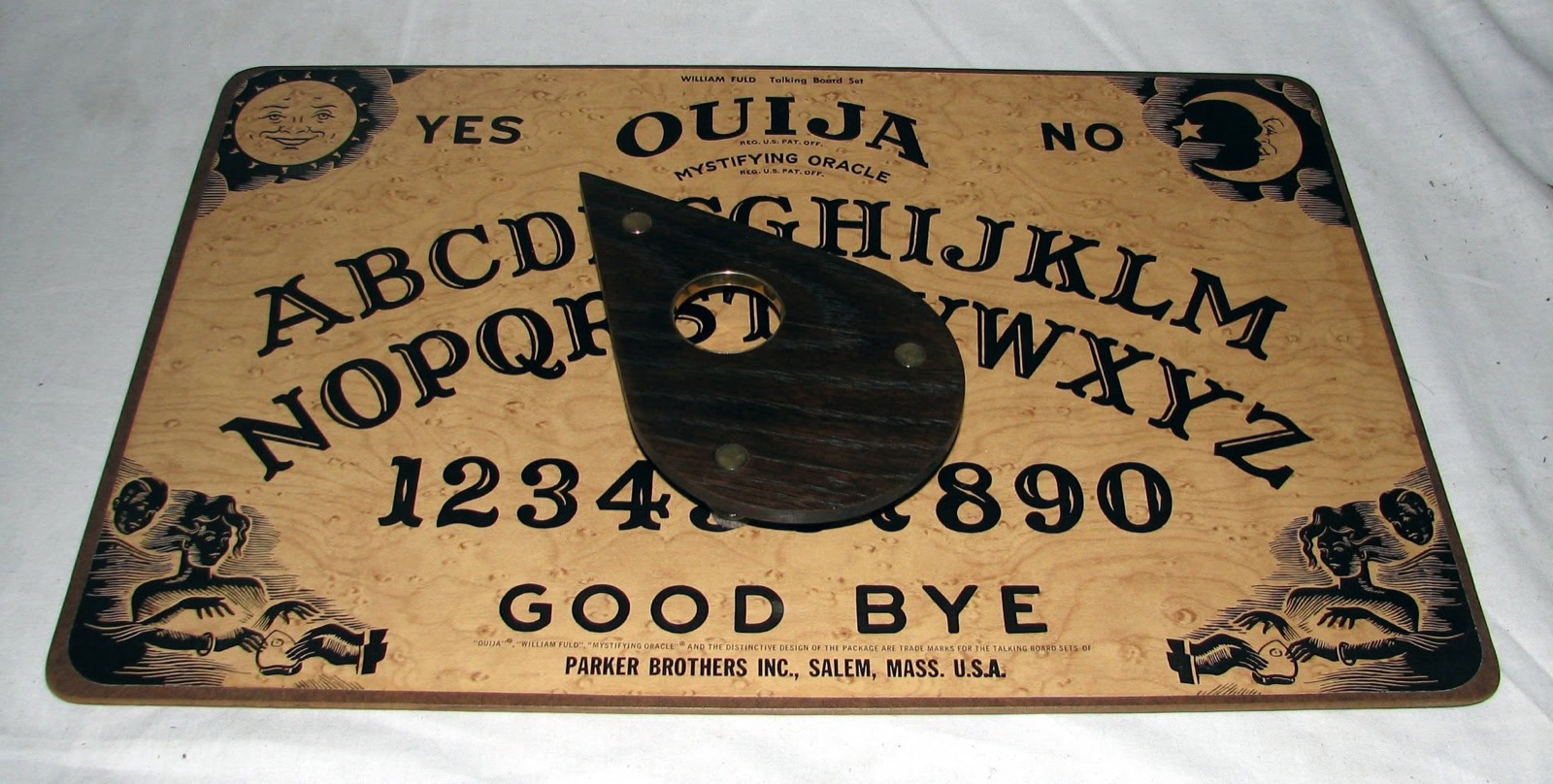
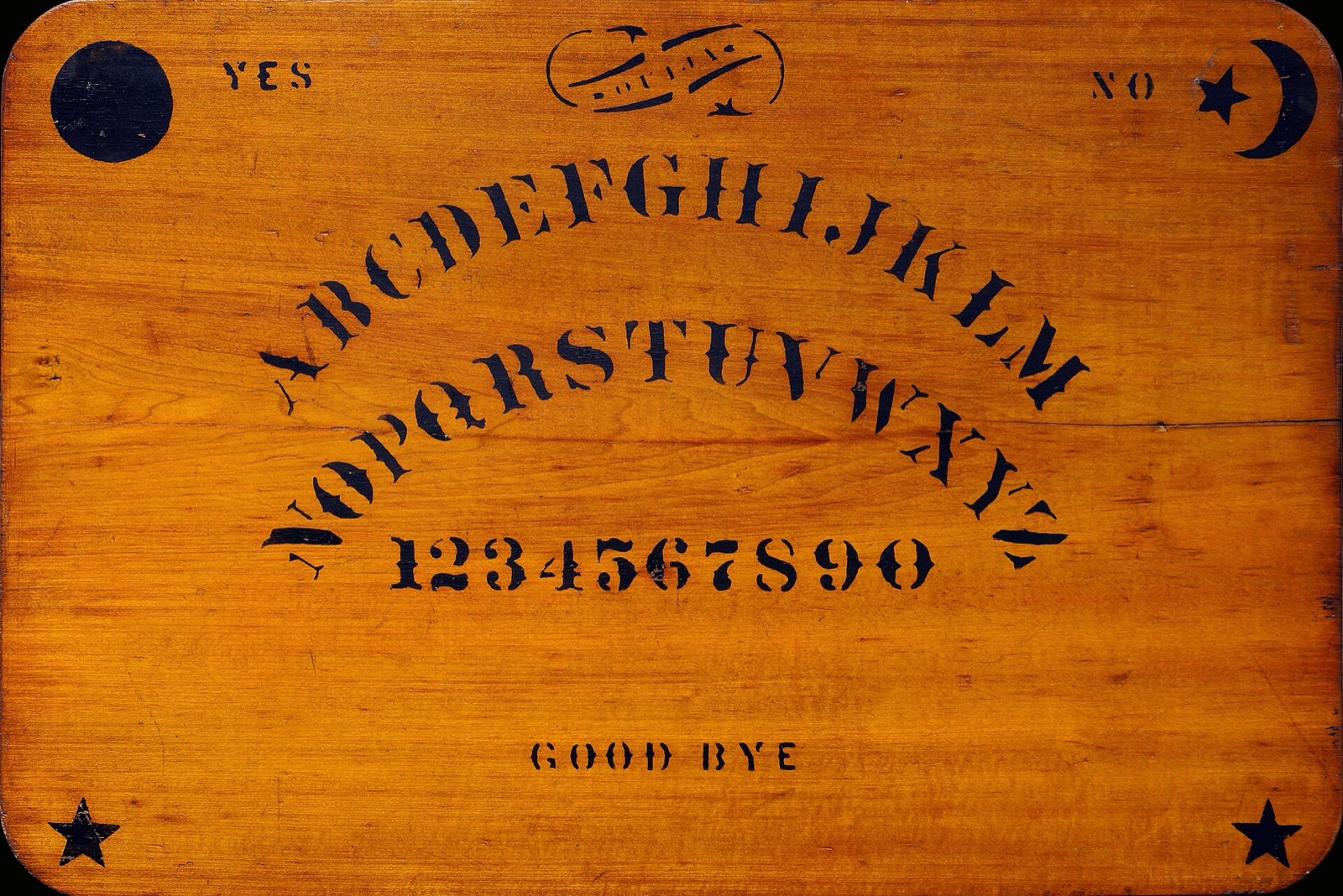
Everything about the modern board was settled in that first decade, and settled well. The alphabet in two arcs, so that the pointer travels a curve and not a grid. YES and NO in the upper corners, where the sun and moon go. The numerals in a straight row beneath. GOOD BYE at the foot, which is the most important word on the board and the one the cheap boards leave off. I have a Kennard of about 1890 in the collection, from the months before the trademark, and I measured every character on it to a thousandth of the board's width before I laid out my own.
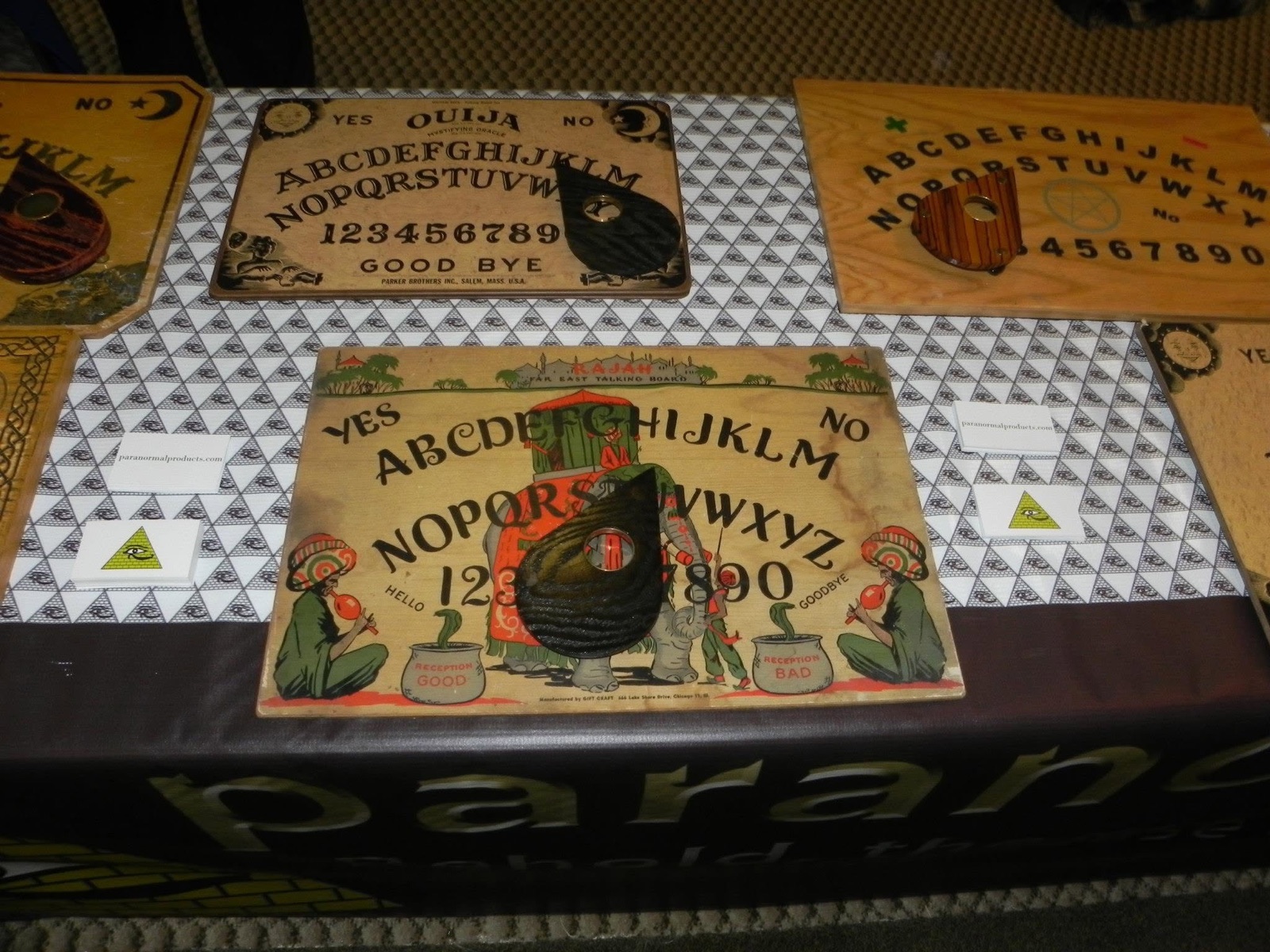
What has changed since is the manufacturing, and all of it for the worse. The original boards were stencilled or lithographed onto solid maple. Within thirty years they were printed on cardboard; within sixty, on hardboard with a plastic pointer; and today the shape that started as a piece of furniture is sold as a novelty in a cardboard box. The instrument survived because the design was right. The object did not.
What I MakeInlaid, Gilded, Numbered
The boards I make
A board of mine is a piece of furniture first. The core is a stable engineered panel so that it cannot cup, veneered on both faces so that it stays flat for a century, the face in white oak, walnut or the timber you choose. The characters are not printed. They are cut from mahogany, or from a contrasting hardwood, and inlaid flush, so that a fingertip drawn across the board feels nothing and the eye reads a letter that will not wear off. The words, YES and NO or YEA and NAY, WELCOME and FAREWELL or GOOD BYE, are inlaid the same way.
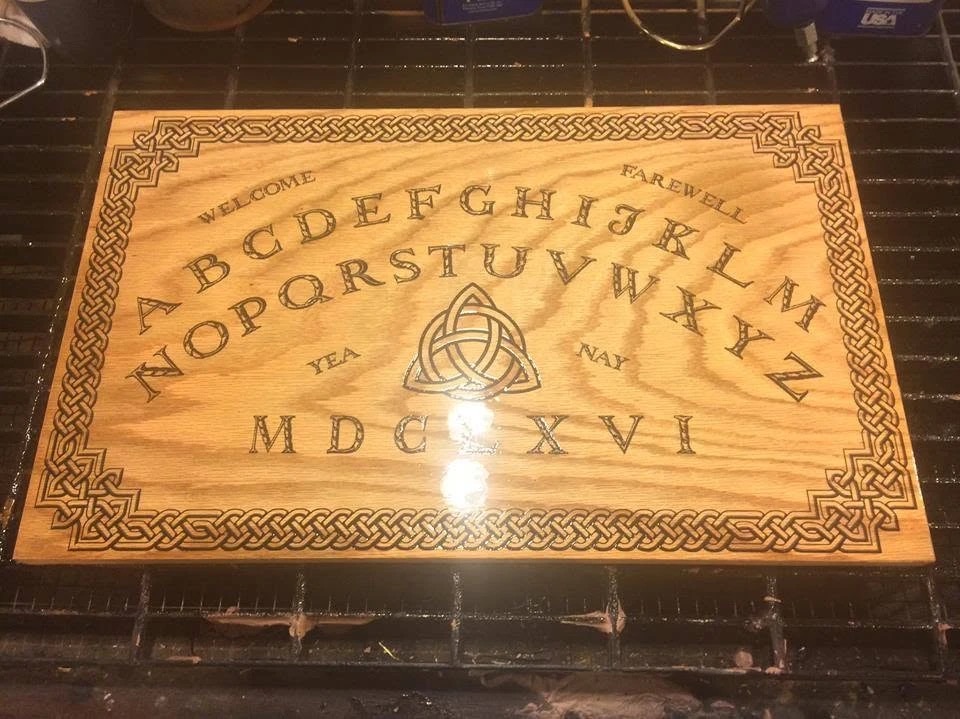
Where the board carries an emblem, it is gilded. My own board, the one photographed below, has a triquetra in 24-carat leaf at its centre and a plaited Celtic border. The gilding is water-gilding on a gesso ground, the method of the picture-frame trade, which is the only method that lasts; it can be burnished, and it will not lift.
The proportion is one to phi, 1 : 1.618, and the pivot of the alphabet's two arcs sits where the golden spiral converges, a little below and to one side of the centre, which is where the eye rests and where the hands drift to. This is the proportion of the pyramid and of the nautilus and of a great many things the New Age has said too much about; I use it because a board cut to it is the one that four hands find comfortable, and I found that out before I found out why.
The first board I made in numbers was an edition of fourteen. Thirteen sold; the fourteenth, the artist's proof, is in my own collection and is not for sale. It is the board in the photograph on the writing planchettes page, carrying three of my pointers, and it is the reason the register exists: I wanted to know where the thirteen went.
The board comes with its pointer, cut to the same proportion, and with its case. The pointer is described on the next page; the case is black-lacquered and lined, and is on the materials page. Every board is numbered on the reverse and entered in the register.
The specification
- ProportionGolden rectangle, 1 : 1.618. Standard size 24 × 14.8 inches; larger to commission.
- FaceWhite oak, black walnut, or a timber to commission. Book-matched where the timber allows.
- CharactersInlaid, not printed. Mahogany as standard; ebony, holly or brass to commission.
- EmblemWater-gilded 24-carat leaf on gesso, burnished. Triquetra, pentagram, sun and moon, or a device of your own.
- WordingYES and NO, or YEA and NAY; GOOD BYE, or FAREWELL. The words of any tradition, or your own, cut to fit.
- FinishOil and wax, hand-rubbed; or a French polish; or dragon's blood over the timber for the red board.
- Supplied withIts pointer, its fitted case, its certificate, and its number in the register.
The ReproductionThe 1890 Board
The Kennard reproduction
For those who want the board as it was in 1890, I make a Kennard: stencilled maple, the sun and moon, the two arcs, GOOD BYE at the foot, measured from an original in my own collection and laid out to a thousandth of its width. It is the board that opens every page of this site, with one of my pointers upon it. It is the only board I make with the characters painted rather than inlaid, because that is how the original was made, and a reproduction that improves on its original is not a reproduction.
It is sold as a reproduction, marked as one on the reverse, and it will not be passed off as an antique by me or, if the register has anything to do with it, by anyone after me.